
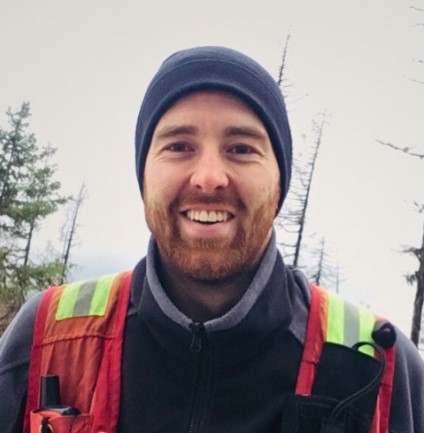
Operations Manager, Nk’Mip Osoyoos Indian Band and West Boundary Community Forest
Peter grew up in Westbank in the Central Okanagan and has worked primarily in the southern interior of BC in silviculture, forest operations, and planning, with experience engaging and collaborating with First Nation communities, public stakeholders, and government. He enjoys implementing innovative projects on a diverse mix of tenures and land ownership types. As the Head of Forest Operations for the Osoyoos Indian Band’s forestry company, Nk’Mip Forestry LLP, and co-manager of the West Boundary Community Forest, Peter is a strong advocate for community-based forestry where management techniques benefit the land, the animals, and the local people. As a non-Indigenous person working for a First Nation, he deeply appreciates the opportunity to listen to, learn from, and build relationships with the OIB community.
Presentation Abstract (co-presented with Eden Hardcastle)
Facilitating climate resilience through operational fuel reduction and post-wildfire intervention
Through two grant-funded initiatives, the Osoyoos Indian Band is facilitating climate resilience through fuel reduction and post-wildfire intervention projects that focus on restoring function to altered landscapes.
Locally, a working prescription for up to 100 hectares of reserve land aims to address forest encroachment in Ponderosa-pine and grassland ecosystems. Working with the Community Resiliency Investment (CRI) Program and the First Nations Emergency Services Society (FNESS), Nk’Mip Forestry is developing a series of treatments to reduce fuel loading while managing at-risk desert species and mitigating wildfire risk in the wildland-urban interface.
On a wider scale, the Sustainable Forestry Initiative (SFI) Indigenous-Led Climate Smart Forestry grant is funding the removal of burnt, unproductive forest and supporting the restoration of a more diverse and wildfire-resistant stand. Two 25-hectare sites were chosen to trial post-wildfire restoration on differing ecotypes (IDFdm1 and MSdm1) and to implement prescriptions that feature both ecologically and culturally significant species, while promoting accessibility and opportunity for the OIB community.
Together, these projects showcase how differing methodologies can approach a common goal of enabling climate resilience and encouraging ecological balance in some of BC’s fire-prone forests.